
By Arnold Wentzel
I like travelling! Not because I see new places, but because I discover stupid questions. Unfortunately, not all my questions have been stupid, some were plain dumb. And my stupid questions in Colombia are a perfect example.
Dumb questions are so because they apparently have obvious answers. Like the time I first arrived in Bogotá and asked “So, where are the Andes?”. The person who picked me up replied “we are in the Andes” while pointing to the mountains all around us.
Racial Classifications
And then there are stupid questions, like the one I asked the same person soon thereafter: “So, what are the different races you have here in Colombia?” When that moment of silence, just before an answer, is just a little longer than usual, you know that the question was really stupid. But she answered with polite surprise, “There are no racial classifications here.”
A stupid question evokes such hesitation because the answerer can see that it makes assumptions that are nonsensical. This is similar to what would happen if you asked a bachelor why he decided to divorce. While uncomfortable to the answerer, they have immense power to change the perspective of the one asking the question.
The Stupidity of my Questions
Fortunately, I was unaware of the stupidity of my questions, and continued with an even worse one, “So, how do you manage without knowing people’s races?”. It was fortunate, because her simple answer, “We don’t need to”, suddenly exposed me to the strangeness of the assumptions that inhabited my small South African mind at the time.
My stupid questions opened my mind and the assumptions tumbled out, but only because, at that moment, I realised their stupidity. There are indeed such things as stupid questions, and the path to good questions are lined with stupid ones. Eventually, all my stupid questions did lead me to ask a good question to this very same person, and that is why I am now married and living in Colombia.
Spaniards Divided the People
Well, it turns out, my question wasn’t that stupid, but I can appreciate it only because I asked those questions. Years later, I discovered that the Spanish conquerors made quite an art out of racial classification. I took the photo seen here at the Museo del Oro in Bogotá. It shows that the Spaniards divided the people in Colombia and surroundings into 75 races, with a pseudoscientific fervour that makes apartheid look, not merely like a grand system of oppression, but also like grand failure of imagination.
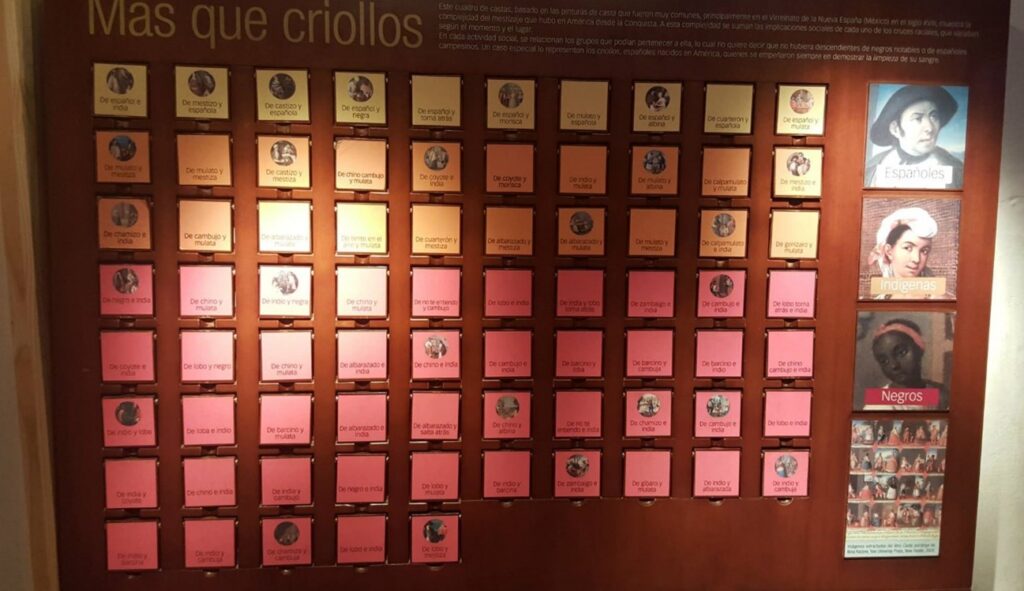
The racial classification in South America disappeared as its inventors lost their power, but Colombian society remains divided. Whereas South African forms ask your race, Colombian forms today ask your estrato. This is determined by your neighbourhood and can range from 1 (extremely poor) to 6 (very rich). While it is not perfect, I prefer the country that continues to provoke me to ask questions to the one that filled my young mind with ‘answers’.
Today, upon meeting a non-Colombian extranjero, I have much more patience with their stupid questions, though less with their stupid jokes (such as the usual ones about cocaine and Pablo Escobar). My stupid questions also revealed much better questions to ask, such as, “What divides the people in your country?” and “Do you understand why?” The answers I received have even been more eye-opening than my initial stupid questions. I have never asked these questions of a fellow South African, but next time I meet one, I just might.

Arnold Wentzel
has been living and teaching in Colombia since 2017
2 Responses
I came across stupid questions asked by a Colombian visiting South African: where are all the dogs? In Colombia dogs are everywhere, not only pampered pooches with dog walkers, but every little town or city have pavement specials without owners running around everywhere.
Answers to stupid questions broadens your horizons and enriches your life.
I love Colombia but South Africa more.
I totally agree. And when we ask them, we are only curious and interested to learn.