PART 1 – By Janine Deane-Dinnis
Rhodesian emigration – a personal story of Ramsey Jeffries George Deane-Dinnis of the parish of Arundel, Sussex. He was a descendent of the notorious ‘Hanging Judge Jeffries’, had attempted to follow in the footsteps of several seafaring ancestors and join the Royal Navy.
They turned him away however; he was colour blind, and thus of no use to them as a naval officer who was unable to tell the difference between blue and green! This was in 1932. Britain had a Labour government and was in the throes of an epic economic depression, plus the UK and Europe would soon be facing deeply troubling times in the years to come.
Rhodesian Emigration
As a result of the Navy’s rejection, Din (as he was called by his friends), made the life-changing decision to leave his family and everything familiar, to venture into the unknown and travel across the world to become a student tobacco farmer in Southern Rhodesia, with a view to eventually getting his own farm.
This was a brave choice for a young man of 19, who was not known for his spontaneity and had never before left England. (Africa then, was not just an 11-hour flight away!)
Journey to the Cape
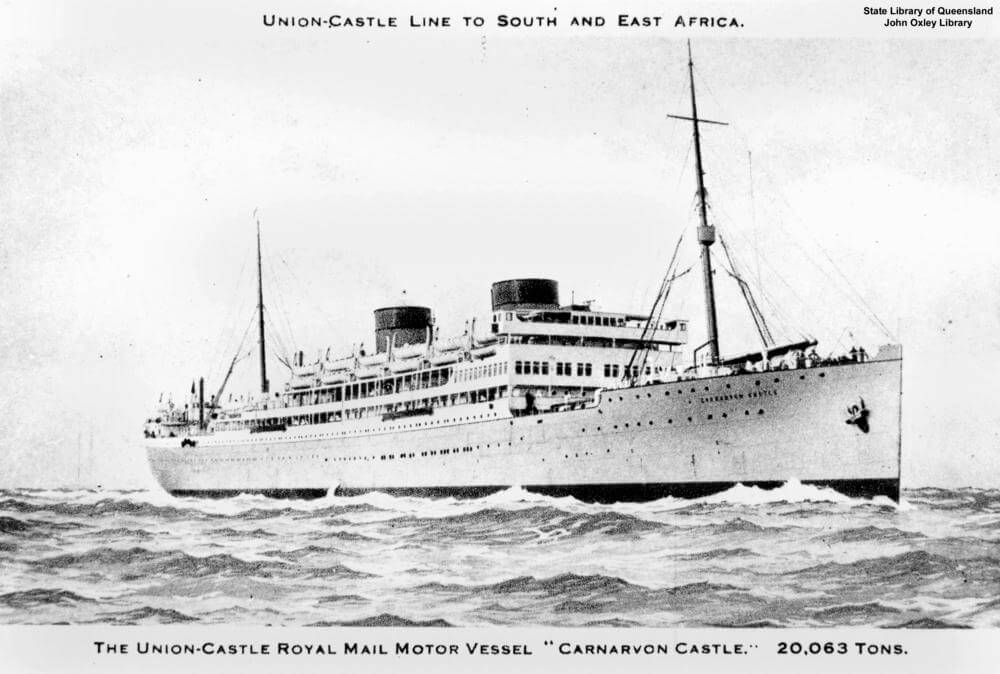
Arrangements were made for his passage to Cape Town on the Union Castle boat, Carnarvon Castle, with the purchase of a return ticket (compulsory for all immigrants) which cost the princely sum of £28.
Apart from some clothes, a lead-lined chest and a collapsible chair for use on deck (as no seating was provided for 3rd class passengers!) he had £100 savings of which £30 was to cover his farming tuition.
As the ship sailed away from Southampton, Din mulled over his circumstances. Here he was, an immature youth with no qualifications except for an Oxford & Cambridge Leaving Certificate from a prestigious English Public School, which had taught him how to spend money and behave like a sporting gentleman, but given him no knowledge whatsoever of how to go about earning a living!
The voyage itself was exciting but uneventful; he made friends with 2 other young men returning home to South Africa, but was troubled when, just before arriving at Cape Town, the two men told him they would have to part. This was due, they explained, to the continuing hostility, hatred even, by the Afrikaner people toward the British because of the Anglo-Boer War. Their parents, they went on, would consider him a ‘rooinek’ and introducing him could cause considerable unpleasantness!
The ‘Boat Train’ to Salisbury
The ship arrived early morning into Cape Town harbour, with a sun already over Table Mountain – a beautiful sight indeed. On disembarking, Din then took the ‘boat train’ to Salisbury, the capital city of Southern Rhodesia, a journey of some 1500 miles; this for the boy who before then had only ever travelled 60 miles by train!
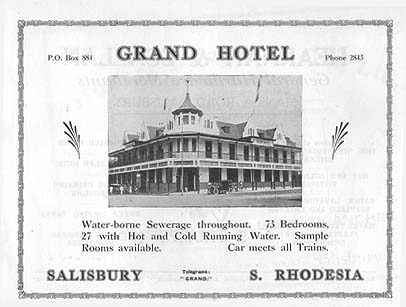
After several adventures, one of which almost got him sent back to England by an overzealous immigration official in Bulawayo, he eventually arrived at his destination and after spending the night in the Grand Hotel and banking his cash (now dropped considerably in value as a result of South Africa having gone off the gold standard) was driven over dreadful dirt roads, through breathtaking scenery, in 30° heat to the start of his new life.
A New Life Begins
The 4000 acre farm in the Umvokwes, 60 miles from Salisbury, was ideally suited to growing tobacco and there was much to learn about this exciting crop at a time when the worldwide demand was on the increase.
Once Din settled in, it was all systems go. In order to the beat the rains which were due any day, the fields had to be ploughed by a team of oxen, working day and night, either by moonlight or the meagre light of paraffin lamps.
As time went on Din adjusted well to the hard but satisfying life on the farm, learning much from Marokwe, the ‘boss boy’ who’d worked there since 1912. He learnt to inspan oxen, burn bricks and build sheds, avoid snakes, manage cattle, dairy and pigs and even how to castrate and kill young porkers and cure bacon, in fact, how to become a ‘jack of all trades’. He also learned if he wanted to get any work done, not to demand anything from the labour force he was not prepared to do himself!
The African Wildlife
One day after a huge commotion they were told a leopard had broken into the hen house and killed many of the birds. Din and Marokwe took shotguns and followed the leopard’s spoor, but the wily animal led them to the edge of thick elephant grass which made it too dangerous to follow so they had to give up.

He loved the freedom and wide open spaces and knew the decision to come to Africa, and be part of the wave or Rhodesian emigration, had been the right one. At that time there were only about 60,000 white people in the whole country. Travelling by road was difficult and became impossible as the rivers flooded after the rains, which meant trips to town were few and far between and socialising almost nonexistent.
Tobacco
There was still a high demand for tobacco; however, due to the lingering effects of the economic depression, the prices had plummeted, which meant a serious drop in earnings for that year’s crop. The outcome of this was that the farmer decided there and then to cut his losses and halt any further tobacco growing, which also meant Din’s position as a student farmer became null and void. This was a terrible blow as the man refused to return any of Din’s tuition fee and jobs were scarce. Din’s small savings were rapidly running out and his future looked very bleak indeed.
THIS RHODESIAN EMIGRATION STORY IS TO BE CONTINUED…

Janine Deane-Dinnis
Janine is a writer and works with businesses to help with their content creation. You can find out more on her Amathuba Network website.

You can enjoy another article by Janine here: On Being a Dangerous Dreamer
3 Responses
[…] can read more by Janine in ‘A World Away Part 1’ and ‘On Being a Dangerous […]
Wonderful, Janine. I have read it before, but it keeps inspiring. Well done! best, will
Thank you, Will for your commendation, always keeps me going!